PAVING VS. CONCRETE DRIVEWAY:
WHICH ACTUALLY HOLDS UP IN CAPE TOWN?
Concrete wins on day-one cost. Here’s what actually happens to each surface over twenty Cape Town winters — and which one you’re still repairing.
Search this question, and almost every result answers it the same way: a price-per-square-metre table, a verdict, done. That’s not the wrong answer. It’s just answering the question that matters least over the life of a driveway.
A driveway isn’t a five-year decision. It’s something you’ll drive over, park on, and look at every day for the next two decades. The material that costs less to install isn’t automatically the material that costs less to own. And in Cape Town specifically, where a driveway spends six months of the year soaked and six months baking in UV, the gap between “cheaper now” and “cheaper over time” is wider than most comparisons let on.
The Upfront Cost Difference, in Relative Terms
Concrete is generally the lower entry cost of the two, and paving, particularly clay brick or premium interlocking pavers, usually costs more to install. That much is true and worth saying plainly rather than dodging.
What the price-table comparisons leave out is what that upfront gap is actually paying for. A poured concrete slab is one continuous surface: fast to install, minimal labour once the formwork is in. Paving is thousands of individual units, each one laid, levelled and jointed by hand on top of a properly compacted base. You’re paying more upfront for a fundamentally more labour-intensive installation, which is also exactly what gives paving its real advantage later.
How Each One Actually Handles a Cape Town Winter
This is where the comparison usually gets thin, and where it matters most.
Concrete is a single rigid slab. It doesn’t flex, which means when the ground underneath it moves and Cape Town’s clay-heavy soils in areas like the Southern Suburbs do shift with the wet-dry cycle between winter rain and summer heat the slab has nowhere to give. It cracks. Once a crack forms, it’s there permanently; concrete doesn’t self-heal, and a patched crack always shows as a patch. UV exposure adds to this over years, making the surface more brittle and more prone to it happening again.
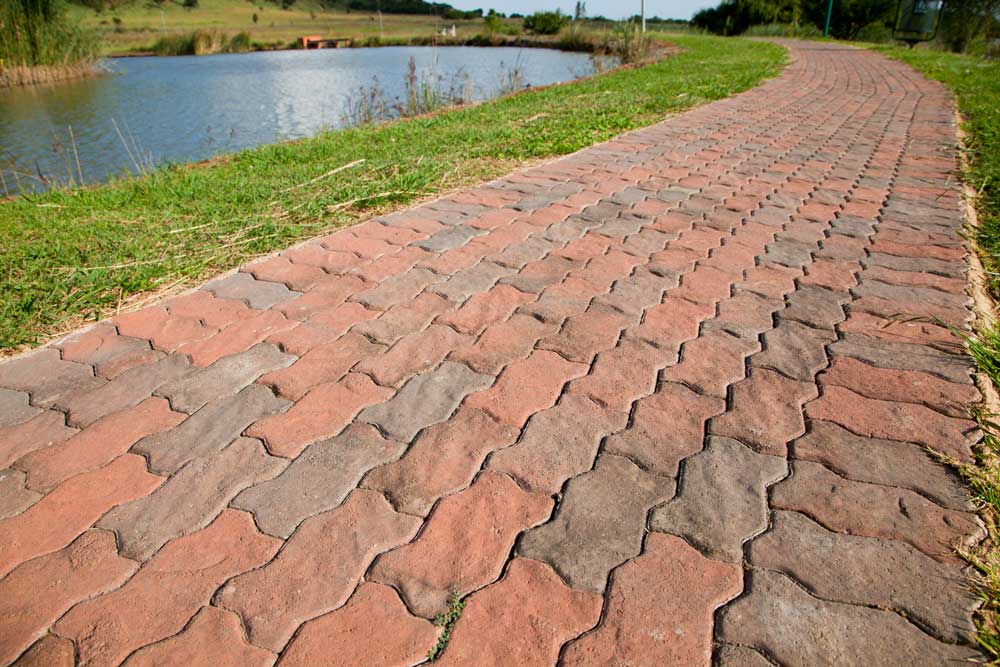
Paving handles the same ground movement completely differently. Because it’s made of individual units laid on a flexible base of compacted stone and sand, the surface can move slightly with the ground without cracking; each paver shifts a fraction of a millimetre rather than the whole surface tearing. Properly installed paving actually performs better, not worse, on ground that moves seasonally, which describes a lot of Cape Town properties.
A poured slab has nowhere to give when the ground moves. It cracks, and once it cracks, it’s there permanently.
Drainage is the other half of a Cape Town winter. A poured slab is solid, so all rainwater runs off the surface fine if the fall is engineered correctly, a real problem if it isn’t, since there’s no second chance once the concrete has cured. Paving’s joints allow some water to permeate rather than sheet entirely off the surface, which takes some of the load off surface drainage during the kind of sustained winter rain this city gets from May through September.
What Happens When Something Goes Wrong
This is the part of the comparison that price tables miss entirely, and it’s the biggest practical difference between the two.
If a section of a concrete driveway cracks, sinks, or gets stained beyond cleaning, the realistic fix is breaking out that whole section and re-pouring it — a genuinely disruptive job, and one where matching the new concrete’s colour and finish to twenty-year-old concrete is close to impossible. You end up with a visible patch for the rest of the driveway’s life.
If a paver cracks, stains, or a small area settles unevenly, the fix is lifting the affected pavers, correcting the base underneath, and relaying them, often using pavers pulled from a low-visibility spot on the same driveway so the repair is genuinely invisible, not just close. A single-paver repair is also simply a smaller, cheaper job than breaking out and re-pouring a slab section. Over a driveway’s full lifespan, this is usually where paving’s higher install cost gets earned back.
This kind of small, contained repair is only possible because of how the surface was built in the first place. See how we install driveway paving with proper base preparation from day one, so repairs stay this simple twenty years in.
Look and Resale Value
Concrete’s finish options are real but narrower: a plain grey slab, or a stamped/coloured finish that adds cost and starts to close the price gap with paving anyway. Paving offers a genuinely wider range: clay brick that holds its colour permanently, interlocking concrete in multiple tones and patterns, cobble for a more traditional look. For a driveway that’s the first thing anyone sees arriving at the property, that range matters more than it might seem. First impressions matter for resale, and a cracked or dated driveway is one of the first things a buyer notices before they’ve even reached the front door.
Driveways vs. Patios: Why the Answer Isn’t Always the Same
It’s worth being direct that this comparison changes depending on what you’re building. A driveway carries real, repeated vehicle load: the weight of a car, plus the turning force of the wheels as it reverses in and out, day after day. That’s exactly the load case where paving’s flexible, repairable base has the clearest advantage over a rigid slab.
A patio doesn’t carry that load. For a purely pedestrian surface, concrete’s downsides (cracking under load, disruptive repairs) matter less, and its lower cost is a more straightforward win. This is genuinely one of the few cases where the right material answer depends on which surface you’re actually building; a driveway and a patio aren’t the same decision wearing different labels.
Making the Decision for Your Own Driveway
The honest version of this comparison is that concrete wins on day-one cost, and paving wins on almost everything that happens afterwards: durability against ground movement, repairability, and how the driveway looks ten years in. For a surface that’s carrying a vehicle daily through a Cape Town winter, that trade tends to favour paving.
If you’re weighing this up for your own property, request a free quote for driveway paving, and we’ll show you the clay brick, interlocking and cobble options side by side, priced for your specific driveway.
Ready to See Real Paving Options for Your Driveway?
Free site consultation, a written breakdown of what’s included, and no obligation — we’ll come to you.
Get A Free Quote Today!